Alphabet's AI buildout now runs on debt and new shares, not spare cash
Alphabet spent $51.4 billion on capital projects last quarter, more than its operations brought in. How it filled the gap changes what kind of company it is.
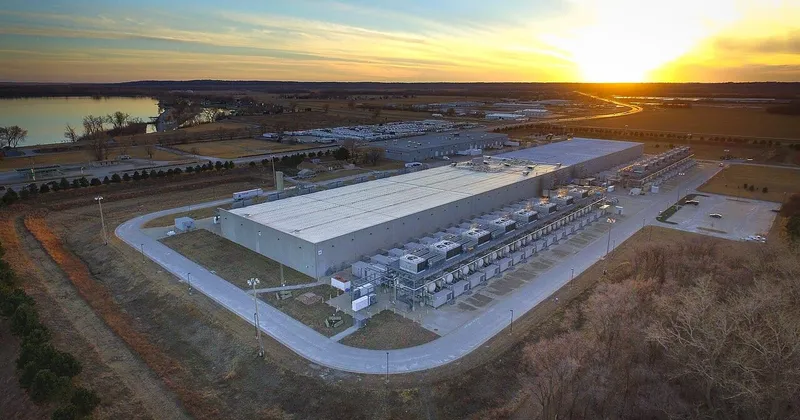
Alphabet reported third-quarter revenue of $127.6 billion on October 28, up 25% from a year earlier, with Google Cloud more than doubling to $30.7 billion. It also spent $51.4 billion on property and equipment, more than the $42.3 billion its operations generated, leaving free cash flow at negative $9.1 billion, according to its earnings release. Its Class A shares fell 12.6% the next day to $283.82, their worst day since the stock began trading in 2004, Fortune reported.
The cloud number was strong. The reaction was about something else: Alphabet no longer pays for its own growth out of its own cash, and the quarter showed how far that shift has gone.
Where the money came from
The financing section of the release tells the story. In the quarter, Alphabet raised $29.0 billion from new debt, including $28.7 billion of senior unsecured notes, and $12.4 billion from selling new shares through an at-the-market program. It bought back no stock at all, against $11.5 billion of buybacks in the same quarter last year. It still paid $2.9 billion in dividends on its common and preferred stock.
Long-term debt stood at $125.1 billion at the end of September, up from $21.6 billion a year earlier, CNBC reported. Free cash flow was also negative in the second quarter, at minus $5.9 billion, according to Fortune, so this is now a pattern rather than one heavy quarter.
The equity side was planned months ago. On June 1, Alphabet announced $80 billion of stock offerings to fund AI infrastructure: $30 billion in underwritten common and mandatory convertible preferred stock, a $40 billion at-the-market program starting in the third quarter, and a $10 billion private placement to Berkshire Hathaway. Fortune put the total raised in June at $84.8 billion.
A detail that changes the dilution story
Luke Lango, an independent tech analyst quoted by Fortune, summed up the market’s worry:
“Alphabet is now funding the AI buildout with shareholders’ money instead of its own cash”
That is broadly right, but the at-the-market sales are not all new money for data centers. In the June announcement, Alphabet said the program was “primarily” meant to support a change in how it handles taxes when employee stock awards vest. Employees still receive their shares net of tax; the company pays the tax bill in cash and then sells an equal amount of new stock through the program. Alphabet expected about $30 billion of the $40 billion to cover 2026 tax obligations, with $27.6 billion of capacity left at the end of September.
In plain terms, the share count still grows, and the effect on existing holders is real. But a large part of the stock sold this way replaces cash that went to employees’ tax bills, rather than cash raised on top of the business. The debt and the June offerings are the clearer funding for the buildout itself.
Why Alphabet is choosing this
The company’s argument is that demand is running ahead of supply. In June, it said Google Cloud’s backlog had nearly doubled in a quarter to more than $460 billion, with about half expected to turn into revenue within 24 months. In the latest release, Alphabet said sales of TPU systems, its in-house AI chips, contributed meaningfully to cloud growth. Cloud’s operating margin widened to 36.2%, Fortune reported, easing fears it had peaked.
Spending will rise again. Alphabet kept its 2026 capital spending forecast at $195 billion to $205 billion, and finance chief Anat Ashkenazi told analysts, as quoted by CNBC:
“We continue to expect our capex to increase significantly in 2027, and will provide further details on our Q4 call”
Analysts expect about $300 billion next year, according to Fortune.
The rest of the quarter gave investors less cover. Search revenue grew 12% to $63.4 billion, below the 19% growth Alphabet reported for the first quarter. Net income was also hit by an $8.7 billion loss on equity securities, which Fortune tied to a mark-to-market change in the value of Alphabet’s SpaceX stake.
What it changes, and what to watch
For most of its history, Alphabet’s cash flow covered its spending with plenty left over for buybacks. It now looks more like a capital-intensive builder that depends on bond and equity markets, which means interest costs, credit ratings and investor appetite now shape how fast it can build. Rivals in cloud and AI face the same constraint, and they draw on the same pools of capital.
For Google Cloud customers, the trade-off is the reverse: more capacity, sooner, paid for partly by investors who are accepting a smaller share of a larger business.
Three things will show whether the bet is working. The fourth-quarter call should give the first firm 2027 spending number. The pace of at-the-market sales will show how much of the program goes beyond tax settlement. And the backlog figure, if Alphabet keeps disclosing it, will show whether contracted demand is turning into revenue fast enough to bring free cash flow back above zero. None of those answers is known yet.
Sources
- Alphabet (SEC Form 8-K, Exhibit 99.1): Q3 2026 results sec.gov
- Alphabet: Proposed $80 billion equity capital raise (June 1, 2026) s206.q4cdn.com
- CNBC (Samantha Subin): Alphabet holds 2026 capex unchanged, expects significant increase in 2027 cnbc.com
- Fortune (Amanda Gerut): Google Cloud revenue doubles as cash flow stays deep red fortune.com
- Fortune (Nick Lichtenberg): Alphabet just had its worst day as a public company fortune.com
More in Analysis
-
DoorDash's $17 billion Instacart deal is priced for a long antitrust fight
DoorDash agreed to buy Instacart for $65 a share. The fee terms, the closing date and the companies' own pitch show both sides expect a hard, slow review.
-
AMD pays $8.2 billion in stock for World Labs to learn what AI chips will need
AMD agreed to buy Fei-Fei Li's World Labs and make her chief scientist. Analysts read the deal as a bet on robotics and physical AI, aimed at Nvidia's early lead.
-
Google keeps its ad exchange after a judge picks rules over a breakup
Judge Brinkema refused to force a sale of AdX but ordered six years of oversight, Prebid access and bid data for publishers. Here is who gains and what an appeal could change.