Apple's first touchscreen Mac is a MacBook Pro with a tandem OLED display
Apple added touch and a tandem OLED panel to the 14- and 16-inch MacBook Pro, a day after launching a cheaper M6 model with a conventional screen. Here is how the two lines differ.
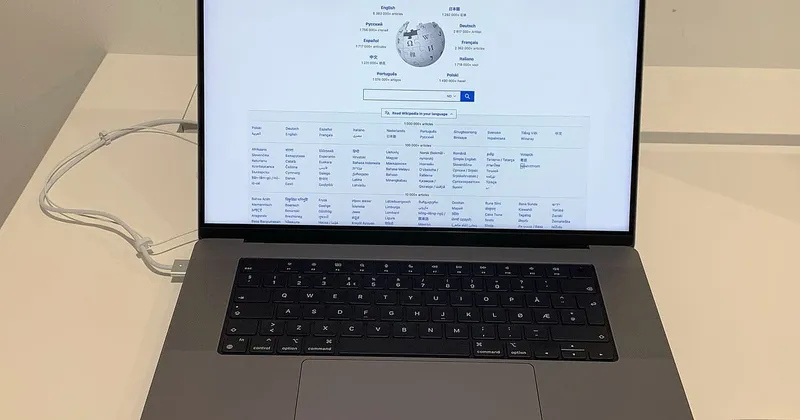
Apple announced a new MacBook Pro with what it calls a PROLED XDR Display on October 28, and it is the first Mac you can touch. The 14-inch and 16-inch models use M5 Pro and M5 Max chips, start at $2,899 in the US, and go on sale November 6, with pre-orders open since launch day.
The timing makes the lineup confusing. One day earlier, Apple released a 14-inch MacBook Pro with the M6 chip for $1,999. That model keeps a conventional Liquid Retina XDR screen and has no touch. So the MacBook Pro is now two products, and the cheaper one carries the newer chip generation.
What the new display does
PROLED XDR is a tandem OLED panel, meaning two stacked layers of self-lit pixels. Apple quotes up to 2,000 nits of peak brightness for both HDR and SDR content, a 10,000,000:1 contrast ratio, and ProMotion refresh from 10Hz to 120Hz. The panel covers P3 and Adobe RGB in one default preset, and Apple says it reaches more than 80 percent of Rec. 2020. Screens measure 14.2 and 16.3 inches.
For comparison, the M6 model’s Liquid Retina XDR screen peaks at 1,600 nits HDR with a 1,000,000:1 contrast ratio. Apple’s chief hardware officer, Johny Srouji, did not hedge:
“PROLED XDR is the world’s best laptop display.” (Apple Newsroom)
Touch is built into the panel itself rather than layered on top, which Apple says cuts latency. The hinge has been redesigned so the screen holds steadier when tapped. macOS translates touches into clicks, so existing apps respond without updates, and Apple names Microsoft Office, Zoom, Lightroom, DaVinci Resolve and Blender among apps adding deeper touch support, with the listed apps due later this year. The Dynamic Island also arrives on the Mac, holding Spotlight, Live Activities and Siri AI.
The chassis got lighter. Apple says the 14-inch now weighs 3 pounds, half a pound less than before, and the 16-inch weighs 4 pounds, 0.7 pounds less. Both are slightly thinner. Battery life is rated at up to 24 hours, and ports include three Thunderbolt 5, HDMI, an SDXC slot and MagSafe.
Two MacBook Pros, two chip generations
The split matters for buyers. The M6 is Apple’s first 2nm-class chip, and Apple claims it has “the world’s fastest CPU core.” In Apple’s own tests against the M5, the M6 model renders Blender scenes and builds Xcode projects up to 1.3 times faster. The OLED models stay on M5 Pro and M5 Max, which Apple did not benchmark against older chips in its announcement.
That does not make the cheaper model faster overall. Pro and Max chips have far more cores and memory. iTWire lists the base 14-inch OLED model in Australia with a 15-core CPU, 16-core GPU, 24GB of memory and 1TB of storage, while the M6 model starts at 16GB and tops out at 32GB. The OLED models go to 128GB of unified memory, and Apple says the M5 Max can run language models with hundreds of billions of parameters on the device.
Connectivity separates them too. The M6 model has Thunderbolt 4 and drives two external displays. The M5 Pro drives three and the M5 Max four, on top of the built-in screen.
Pricing follows from that. The 14-inch M5 Pro starts at $2,899, the 16-inch at $3,399, and M5 Max versions at $4,499 and $4,799. The $900 gap between the two 14-inch entry models buys the OLED panel, touch, a lighter body, Thunderbolt 5 and the Pro chip. The National reports that the M6 model holds the price set after Apple’s July increases, which the paper links to rising chip costs.
The case against touch
Early reactions are not all warm. YouTuber Dave2D, in a video summarised by Notebookcheck, doubts that touch adds much for pro work. His example is video editing, where he finds a mouse or trackpad does the same jobs more efficiently. He also showed that fingerprints build up on the nano-texture option, not only the glossy panel, though the problem was milder than he expected. He did credit Apple’s interface changes for making touch navigation easier.
The design also has limits that Windows buyers will notice. As iTWire points out, the screen does not fold back into a tablet position, and there is no pen support. Windows makers have sold 360-degree convertibles for more than a decade, and some current models, such as Lenovo’s Yoga 9n, accept a pen. Apple’s version is a clamshell laptop you can reach out and poke, not a two-in-one.
Who should care, and what is still unknown
For photo, video and colour work, the display is the main reason to look. High peak brightness, deep blacks and Adobe RGB coverage in one panel are a clear step up from the Liquid Retina XDR panel in the M6 model. Developers testing iPhone and iPad layouts may also find touch handy.
For most other buyers, the M6 model is the more sensible MacBook Pro. It costs $900 less, has the newer CPU, and Apple rates its battery at the same 24 hours.
Several questions remain until review units are tested. Apple has not published core-for-core benchmarks for the OLED models against the previous M5 Pro and M5 Max machines. Battery life on OLED depends heavily on content, and Apple’s figure comes from its own September tests. Long-term OLED burn-in on static macOS elements, such as the menu bar and Dock, is something only months of use will show. And it is not yet clear how many third-party apps will treat touch as more than a stand-in for the mouse.
Sources
- Apple Newsroom: Apple unveils groundbreaking MacBook Pro with PROLED XDR Display apple.com
- Apple Newsroom: Apple introduces the new 14-inch MacBook Pro with M6 apple.com
- Notebookcheck: YouTuber Dave2D questions key selling point of PROLED XDR display notebookcheck.net
- iTWire: Apple finally puts touch on the Mac itwire.com
- The National: Apple unveils M6-powered MacBook Pro and iMac without raising prices thenationalnews.com
More in Hardware
-
Nvidia's RTX Spark laptops are on sale, and early tests split on the CPU
Windows laptops built on Nvidia's N1X chip shipped from six brands starting at $2,599. Early testing praises the GPU and large memory pool but disagrees about the Arm CPU.
-
A YMTC employee says the memory shortage will last three more years, and TrendForce sees Q4 DRAM prices rising
An unnamed employee told The Wire China the memory crunch runs to about 2029, while TrendForce says Q4 DRAM contract talks point to higher prices. Neither is an official forecast.
-
A leaker says Nvidia's RTX 60 and most of AMD's RDNA 5 will skip 2027
A post on the AnandTech forum claims both next-generation GPU families arrive in 2028, with one AMD card in 2027. It is an unsourced leak, and Nvidia and AMD have not commented.