Surface Laptop Ultra reviews agree on the build and split on the screen
Microsoft's RTX Spark laptop impresses reviewers on build and local AI, but measured brightness, dimming and value differ sharply across the first full reviews.
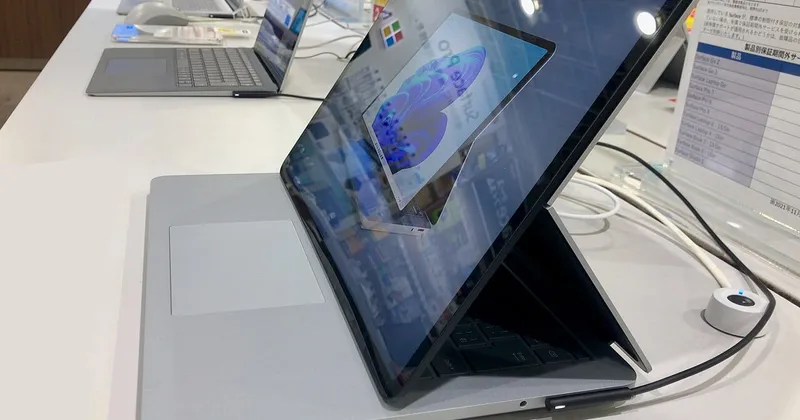
Microsoft’s Surface Laptop Ultra went on sale on October 16 at a starting price of $2,599, according to Microsoft’s pre-order announcement. It is the first Surface built on Nvidia’s Arm-based RTX Spark chip, with up to 20 CPU cores, a 6,144-core Blackwell GPU and up to 128 GB of unified memory. The first full reviews agree it is a beautifully made, fast machine for local AI work. They do not agree on whether its 15-inch Mini-LED screen is a highlight or its biggest flaw.
We read three full reviews, from Notebookcheck, PCWorld and CGMagazine, each tested on a different configuration. That matters for the price argument below.
Where reviewers agree
Build quality is the easy part. Notebookcheck’s Andreas Osthoff lists excellent build quality first among the positives, PCWorld’s Mark Hachman calls the construction rock-solid, and CGMagazine’s Brendan Frye praises the premium design and haptic touchpad. PCWorld adds one caveat on the hardware: at 4.41 pounds, it calls the laptop heavier than you’d expect.
Multi-core and GPU performance land well everywhere. Notebookcheck says the GPU performs very much like a GeForce RTX 5070 and gave the laptop a 96% games score. PCWorld measured 39.9 tokens per second running a Qwen model in LM Studio, ahead of the MSI Raider it tested (15.2) but behind an Asus ROG Strix (61.9). CGMagazine ran DaVinci Resolve, the Adobe suite and ComfyUI without trouble and says local AI agents worked offline.
The price draws the same complaint from every outlet. Configurations run from $2,599.99 to $5,899.99, per CGMagazine’s breakdown. PCWorld’s verdict says the machine offers a lot,
“all for a price that seems totally unrealistic in the 2026 economy.”
Where they split, and why
The display is the real disagreement. Microsoft promises 1,000 nits in SDR and 2,000 nits peak HDR. Notebookcheck measured about 1,101 nits in SDR and 2,034 nits in HDR, so it beat the claim. PCWorld measured only 792 nits in SDR on its unit. CGMagazine did not publish measurements and simply calls the panel “absolutely stunning.”
Brightness is not Notebookcheck’s problem. The German lab found no way to turn on local dimming, measured a high black level and slow response times of around 57 ms, and saw ghosting even at 120 Hz. It also detected PWM flicker at 4,650 Hz. Its headline calls the panel “a problem,” and the verdict is blunt:
“The problem, however, is the bad implementation of the Mini-LED panel.”
PCWorld, by contrast, lists a great display among its positives, and after publication Microsoft told the outlet the panel has 1,344 local dimming zones. None of the three reviews explains why one lab could not get dimming to work while Microsoft says the hardware is there. Different units, firmware or display modes could each explain part of it. Until Microsoft or a fourth lab settles it, treat the screen as unproven if you edit HDR video or are sensitive to flicker.
Everyday speed is the second split. PCWorld found default single-core performance disappointing and warns it may slow the interface, with scores climbing only after moving the power slider to Best performance. Notebookcheck, testing a 64 GB unit, rates overall performance very good and notes it holds up on battery. The gap looks like a power-mode question more than a chip question, so buyers should expect to change that setting.
Battery life depends on what you do. Notebookcheck got 10.5 hours of Wi-Fi browsing at 150 nits, about 7 hours at 500 nits and 4.5 hours at full brightness, and called runtime “not great.” PCWorld recorded 7 hours 57 minutes of 4K streaming and 10 hours 3 minutes in an office benchmark. CGMagazine saw 3 to 4 hours under heavy AI or ray-traced gaming loads.
Gaming splits along test method. Notebookcheck says most games run through emulation and names Call of Duty, Battlefield 6 and F1 25 as not yet compatible. CGMagazine found Cyberpunk 2077 and Baldur’s Gate 3 playable but warns that games with unsupported anti-cheat may not run at all. PCWorld reports 104 fps in Cyberpunk at 1080p with DLSS frame generation, a number that leans on upscaling.
Who should buy, and who should wait
Buy it if you run local models, CUDA tools or Adobe and Resolve workflows on Windows and want that in a thin laptop rather than a 300-watt gaming machine. PCWorld measured the Surface drawing 133 to 144 watts in a game benchmark, against 290 to 305 watts for the MSI Raider. CGMagazine frames the buyer clearly:
“This is a laptop you buy when you need a serious professional workflow and ultimately expect to make money from your work.”
Skip it if you mainly want a fast Windows laptop for office work, or a gaming laptop. The single-core results, the game compatibility gaps and the entry price all point elsewhere. Notebookcheck names the Asus ProArt P16, the 16-inch MacBook Pro with M5 Max and Samsung’s Galaxy Book6 Ultra among the machines it compares against.
If you are interested but not in a hurry, wait. Two open questions could change the verdict: whether a firmware update fixes local dimming and response times, and how fast game and app makers ship Arm-native builds. Notebookcheck expects game compatibility to improve. Its 87% score and CGMagazine’s 8.5 out of 10 describe a strong first version that is priced as if it were already finished.
Sources
- Notebookcheck: Microsoft Surface Laptop Ultra RTX Spark review notebookcheck.net
- PCWorld: Microsoft's Surface Laptop Ultra review pcworld.com
- CGMagazine: Microsoft Surface Laptop Ultra review cgmagonline.com
- Windows Experience Blog: Pre-order our most powerful Surface devices ever blogs.windows.com
More in Reviews
-
Galaxy Tab S12 Ultra reviews praise the tablet and doubt the laptop pitch
Reviewers praise the Tab S12 Ultra's screen, speed and battery, but split on whether a $1,800 tablet-and-keyboard kit can replace a laptop.
-
Apple Watch Series 12 reviews like the new heart sensor and Readiness score, not the battery
Wareable, Macworld and iPhone in Canada agree the Series 12 is a good smartwatch with better health sensing. They disagree on reliability and battery.
-
iPhone 18 Pro reviews: faster and longer-lasting, but the price rise is hard to ignore
Reviews from 9to5Mac, Expert Reviews and Smartprix agree the iPhone 18 Pro is a refinement. They split on the camera and on whether the higher price is justified.