Apple's Mac mini gets the M6 and the Mac Studio gets a four-die M5 Ultra
Apple announced the M6 Mac mini and an M5 Ultra Mac Studio on August 25, with preorders open and shipping on September 22. The chips are Apple's own claims for now.
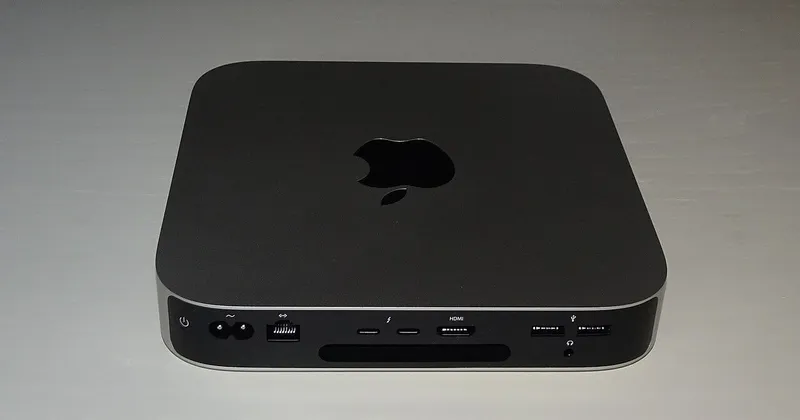
Apple announced a new Mac mini built on the M6 chip and a new Mac Studio with an M5 Ultra on 25 August 2026. Preorders opened that day and all models ship on 22 September, according to Daring Fireball. Performance figures below are Apple’s own claims; independent benchmarks were not available when this was written.
The Mac mini is also offered with an M5 Pro, and the Mac Studio with an M5 Max.
The M6: first 2 nm chip in a Mac mini
Apple calls the M6 its first 2-nanometer chip. Daring Fireball lists a 12-core CPU, a 12-core GPU with Neural Accelerators, a dual 16-core Neural Engine and up to 170GB/s of unified memory bandwidth. Unbox.ph, a Philippine gadget site, says the CPU has two more cores than the M5 and that Apple claims up to 1.2 times the multithreaded performance of the M5 and 30% faster neural processing.
Unbox.ph also reports that the chassis size is unchanged, and that memory is capped at 32GB. We could only find that cap in one source, so check Apple’s configurator before counting on it for a larger workload. ETV Bharat adds that the mini gets Wi-Fi 7 and Bluetooth 6, and keeps Thunderbolt 4 rather than moving to Thunderbolt 5.
That last detail is the one to notice. Anyone with a fast external SSD or a multi-display setup should read the port list before ordering. The faster ports are reserved for the Studio, and the mini’s chip is quicker than the connectors around it.
The M5 Ultra: four dies working as one
The bigger engineering change is in the Studio. Daring Fireball says the M5 Ultra is the first M-series chip to combine four dies using Apple’s UltraFusion link, with up to 36 CPU cores, up to 80 GPU cores and 1.2TB/s of unified memory bandwidth. Apple says that bandwidth is 50% more than the M3 Ultra’s.
Unbox.ph describes the design as two dual-die M5 Max chips joined by UltraFusion so they act as one processor. Against the M3 Ultra, it lists Apple’s claims of up to 25% faster single-threaded and 30% faster multithreaded performance, and a peak AI figure of 4.3 times the M3 Ultra and nearly 10 times the M1 Ultra. ETV Bharat gives the maximum memory as 512GB and says the Studio has Thunderbolt 5, Wi-Fi 7 and faster storage, and that several Studios can be linked to share AI workloads.
The 512GB ceiling and the memory bandwidth point to the intended buyer. These are machines for running large local AI models and heavy video or 3D work on a desk, not general office computers. The multi-Studio linking feature points the same way.
What it costs
We did not find US prices in the sources we read, so only local figures are available. ETV Bharat lists the M6 Mac mini from Rs 99,900 in India, and Unbox.ph lists it from Php 64,990 in the Philippines. The M5 Ultra Mac Studio starts at Rs 6,29,900 and Php 379,990 respectively. ETV Bharat says the M5 Ultra Studio’s starting price is higher than the previous M3 Ultra model’s, but it gives no M3 Ultra price to compare against.
Currency and tax differences make those numbers hard to compare across markets. The direction is clear, though: the top Studio is priced as a professional tool.
Who should wait
Early buyers should know about one open question. Daring Fireball says the machines ship with macOS 27, named “Golden Gate,” and that Apple declined to comment on whether macOS 27 would be public by 22 September when asked. If you buy on day one, you may get a machine that arrives on a new operating system before the release is generally available.
Current M5 and M4 owners have little reason to move on the basis of the M6 alone: Apple’s own claim is up to 1.2 times the M5’s multithreaded speed, which is a modest step. The M5 Ultra is a different case, since it changes the top of the line rather than adding to it, and its buyers will be the ones who tell us if the four-die design delivers. Watch for third-party benchmarks and thermal tests after the 22 September shipments.
Sources
More in Hardware
-
Apple's first touchscreen Mac is a MacBook Pro with a tandem OLED display
Apple added touch and a tandem OLED panel to the 14- and 16-inch MacBook Pro, a day after launching a cheaper M6 model with a conventional screen. Here is how the two lines differ.
-
Nvidia's RTX Spark laptops are on sale, and early tests split on the CPU
Windows laptops built on Nvidia's N1X chip shipped from six brands starting at $2,599. Early testing praises the GPU and large memory pool but disagrees about the Arm CPU.
-
A YMTC employee says the memory shortage will last three more years, and TrendForce sees Q4 DRAM prices rising
An unnamed employee told The Wire China the memory crunch runs to about 2029, while TrendForce says Q4 DRAM contract talks point to higher prices. Neither is an official forecast.