iPhone 18 Pro starts at $1,199 with a variable-aperture camera and no base iPhone yet
Apple announced the iPhone 18 Pro and Pro Max on September 9 with the 2nm A20 Pro chip. Prices rose by $100, and the standard iPhone 18 is not due until 2027.
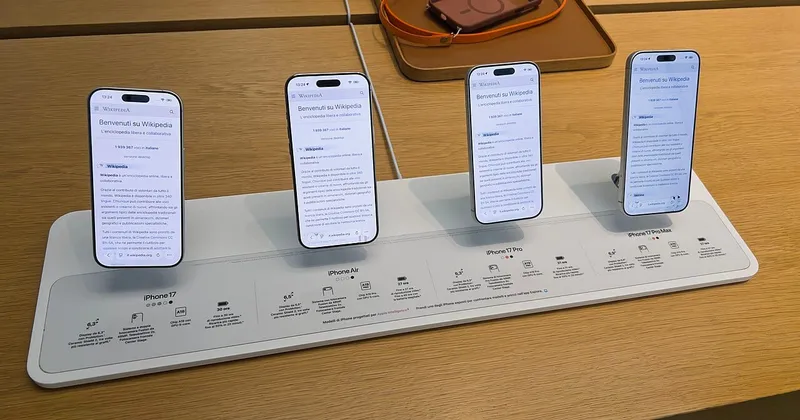
Apple announced the iPhone 18 Pro and iPhone 18 Pro Max on 9 September 2026 at its “Surprise and shine” event. The Pro starts at $1,199 and the Pro Max at $1,299, both with 256GB. Pre-orders open on 12 September and the phones go on sale on 18 September, according to Appleosophy.
The notable part is what is missing: there is no standard iPhone 18 this autumn. Tecnoblog reports that the regular iPhone 18 and a second-generation iPhone Air are not announced yet and are expected in 2027. Anyone who wants a new iPhone this year is choosing between two Pro models.
The price and the storage ladder
Appleosophy lists the iPhone 18 Pro at $1,199 for 256GB, $1,399 for 512GB, $1,799 for 1TB and $2,399 for 2TB. The 2TB option is new for the smaller Pro. The Pro Max runs $1,299, $1,499, $1,899 and $2,499 across the same four tiers.
The article calls the $100 rise on the entry model smaller than the $200 to $300 that had been rumoured. Apple has not explained the increase in the coverage I read, and neither source says what the previous generation cost at launch, so the size of the jump is Appleosophy’s figure rather than something I could cross-check.
The practical point is the gap between tiers. Going from 256GB to 512GB costs $200, and from 512GB to 1TB costs $400. If you only need space for photos, the 256GB model is the one that avoids those steps.
What changed inside
The A20 Pro is built on a 2nm process. Tecnoblog, citing Apple, reports a 6-core CPU up to 20% faster, a 7-core GPU up to 40% faster, 50% more memory bandwidth and a 32-core Neural Engine that Apple says doubles AI processing capacity. Appleosophy adds that Apple claims up to twice the sustained performance of the iPhone 16 Pro, with cooling described as three times better.
All of these are Apple’s figures. Sustained performance is the one worth waiting on, because phones often score well in short bursts and then slow down when hot. Independent tests will show whether the cooling claim holds up in a long game or a video export.
The camera is the most visible change. The 48MP main camera has a variable aperture with six laser-cut blades, which Tecnoblog says adjusts between f/1.4 and f/4.0. Appleosophy says four aperture settings can be set manually in the Camera app and that a developer API offers more control. Apple’s own description from the event:
“Six laser-cut blades smoothly transition between different apertures.”
The telephoto reaches up to 8x optical zoom, and Tecnoblog says all three rear sensors are 48MP. A new Apple Reference Image feature signs image data at capture to help verify edits and authenticity. Neither article explains how that verification is checked by others, so how far it will matter outside Apple’s own apps is unclear.
Design, battery and charging
The phone looks close to the iPhone 17 Pro. The Dynamic Island is smaller, which Appleosophy calls the first redesign since the iPhone 14 Pro. Tecnoblog puts the reduction at about 35%. It can show three Live Activities at once instead of two.
Screens are 6.3 inches on the Pro and 6.9 on the Pro Max, with LTPO+ OLED panels at up to 120Hz, per Tecnoblog. Apple’s video-playback figures are up to 36 hours for the Pro and 45 hours for the Pro Max. Charging reaches 50% in about 15 minutes, according to Appleosophy, which does not say which charger that needs.
Colours are black, silver, a new burgundy and either glacier or white, depending on the outlet. Both agree the orange from the iPhone 17 Pro line is gone.
Who should upgrade
If you own an iPhone 17 Pro, little in these reports is a reason to move. Tecnoblog says the design is close to last year’s, and the main additions are the faster chip, the aperture control and a smaller Dynamic Island. The camera is the only change many people will notice day to day, and only if they shoot manually.
Owners of an iPhone 15 Pro or older have a stronger case, since the jump to 2nm silicon, a bigger Neural Engine and the new camera arrive together. The $1,199 entry price is the cost of getting there.
People who wanted a cheaper iPhone will have to wait for 2027 or buy last year’s model. The open questions are the battery capacity, which Apple lists only as playback hours in the coverage I read, and how the A20 Pro behaves in third-party tests once reviews land.
Sources
More in Phones
-
Apple will replace iPhone Duo units whose inner screens crack at the hinge
Early iPhone Duo owners report inner displays cracking along the fold within days of launch. Apple calls it a small number of units and sends owners to AppleCare, no AppleCare+ needed.
-
South Korea fines Samsung about $15 million over hidden Galaxy game throttling
Korea's Fair Trade Commission set a provisional 20.1 billion won fine for Galaxy S21, S22 and Tab S8 ads that left out GOS speed caps in games. Samsung says it will fight the ruling in court.
-
Galaxy S26 FE costs $50 more than its predecessor and changes little but the chip
Samsung's Galaxy S26 FE goes on sale on September 4 at $699 in the US. It brings an Exynos 2500 and One UI 9, while the battery, screen size and RAM stay the same.